Showing posts with label CU. Show all posts

Wednesday, May 28, 2014

How Your Credit Score Can Affect Getting a Job

Written by Lauren Lind 

Many people aren’t aware that your credit score can affect you in your job search. Depending on the State Law, an employer can in fact check your credit score.  As of July 2013, according to the Colorado Department of Labor & Employment, Colorado is one of the states that strictly limit the circumstances in which employers may use credit reports in making employment decisions. An employer may require applicants and employees to authorize the employer to view their credit reports if the employer is a bank or financial institution, or is required by state or federal law to use credit history for employment purposes. The limited circumstances include a situation where the job involves a contract with the federal departments of defense, intelligence, national security, or space.

Employers may also use credit information if the job is an executive, managerial, or officer position (or professional administrative staff to such positions), and involves at least one of these duties:
• Setting the direction or control of a unit, agency, division, or the entire business
fiduciary responsibility to the employer
• Access to the financial information of customers, employees, or the employer (beyond the information routinely provided in retail transactions), or
• The authority to enter into contracts, collect debts, or issue payments

If you fall under these exceptions or live in a state where employers may use your credit score freely in the hiring process, then you need to be aware of the following:

• Employers might consider you a liability. It is very possible that the employer will correlate your struggles with your credit and home situations with projected ability to be present at work.

• This could be the deal-breaker between you and your competition. If your competitor’s credit score is good and your score is in the dumps then you automatically knock yourself out of the running.

• Bad credit sends you on a downward spiral. It gets exhausting trying to keep up with previous bills after being unemployed. It becomes harder to gain employment, even though you may be qualified in every other area.

• You can say goodbye to a job in finance until your credit is in the clear.  The reasoning for this is fairly simple, if you cannot handle your own finances, what would make the employer believe you could handle anyone else’s finances?

Luckily, since we live in Colorado, your credit score cannot legally be used against you unless you fall under the specifications listed above. Employers want to be able to trust you and believe that if you have a long-term good credit standing, it will relate to your reliability.

Hat tip: Colorado Department of Labor & Employment

Monday, April 7, 2014

How to Retain the Best Employees, and Yourself

Written by Shari Harley 

 Managers: 

The fear of saying what we think and asking for what we want at work is prevalent across organizations. We want more money, but don’t know how to ask for it. We want to advance our careers but are concerned about the impression we’ll make if we ask for more. Instead of making requests, many employees assume they won’t get their needs met and choose to leave their jobs, either physically or emotionally.

Questions Managers Should AskThe key to keeping the best employees engaged and doing their best work is to ask more questions and make it safe to tell the truth.
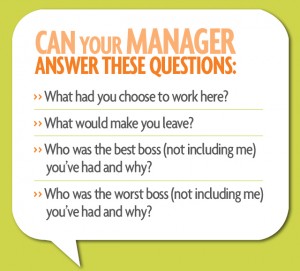
  • Do you know why your employees chose your organization and what would make them leave?
  • Do you know your employees’ best and worst boss?
The answers to these questions tells managers what employees need from the organization, job, and from the manager/employee working relationship. Can your manager answer these questions – that I call Candor Questions – about you? For most people, the answer is no. Most managers don’t ask these questions. And most employees are not comfortable giving this information, especially if the manager hasn’t asked for it.

It’s easy to mistake my book, How to Say Anything to Anyone, as a book about giving feedback. It’s not. It takes me nine chapters to get to feedback. The first eight chapters of the book are about how to create relationships in which you can tell the truth without fear. You can read all the feedback books you want and take numerous training classes on coaching, managing people, giving feedback, and managing conflict, and you’ll still be hesitant to speak up, because a formula for giving feedback is not what you’re missing. What’s missing is being given permission and knowing it’s safe to tell the truth.

How to give feedback

Managers, tell your employees:
“I appreciate you choosing to work here. I want this to be the best career move you’ve made, and I want to be the best boss you’ve had. I don’t want to have to guess what’s important to you. I’d like to ask you some questions to get to know you and your career goals better. Please tell me anything you’re comfortable saying. And if you’re not comfortable answering a question, just know that I’m interested and I care. And if, at any point, you’re comfortable telling me, I’d like to know.”
ManagingQThen ask the Candor Questions during job interviews, one-on-one, and team meetings. We’re always learning how to work with people. So continue asking questions throughout your relationships. These conversations are not one-time events.

If you work for someone who isn’t asking you these questions, offer the information. You could say:
“I wanted to tell you why I chose this organization and job, and what keeps me here. I also want to tell you the things I really need to be happy and do my best work. Is it ok if I share?”
Your manager will be caught off guard, but it is likely that she will also be grateful. It’s much easier to manage people when you know what they need and why. Most managers want this information, it just may not occur to them to ask.

If the language above makes you uncomfortable, you can always blame me. You could say:
“I read this blog and the author suggested I tell you what brought me to this organization and what I really need to be happy here and do my best work. She said I’d be easier to manage if you had that information. Is it ok if I share?”
Yes, this might feel a little awkward at first, but the conversation will flow, and both you and your manager will learn a great deal about each other. The ability to tell the truth starts with asking questions, giving people permission to speak candidly, and listening to the answers.

Wednesday, April 2, 2014

#GoBuffsPro: How Becoming a Buffs Professional Can Benefit You

-->Written by Lauren Lind
Stand out with the Buffs Professional Program certificate! These four workshops offered by Career Services are designed to prepare you for the professional work world.  Learn what it takes to transition into the professional world after college.

April is your last chance this semester to earn your Buffs Professional Program certificate! Simply attend the four workshops (or participate in them online) and attend the career fair. Once you've completed the required workshops and attended the career fair, you'll be invited to attend the Summit event on April 24th. You do not have to complete the classes in any particular order. Below are the in-person workshops.

Explore Majors and Careers
Tuesday, April 8th, 5:30-6:30pm, S350
Learn about majors you're interested in and career assessments. This workshop will allow you to connect your strengths and skills to areas of interest.

Resumes & Networking
Tuesday, April 15th, 5:30-6:30pm, S350
It has been said that 80% of jobs are found through networking. Often times it’s about whom you know and getting your foot in the door.  During this class you can craft a resume from scratch or work on your existing resume.

Internship/Job Search & Interviewing
Tuesday, April 22nd, 5:30-6:30pm, S350
Begin the internship and job search process and learn the ins and outs of how to be successful in your search. This class emphasizes building social media job searching skills and interviewing skills to put you ahead of the competition.

Professionalism Skills
Tuesday, April 29th, 5:30-6:30pm, S350
Gain insight into professionalism on the job and skills to adapt to changing work environments. Learn the professional skills that employers seek in candidates.

This is a unique opportunity to make your application stand out and understand what employers are looking for in candidates. Click here to see the student requirements. 

To get started, email: BuffsPro@Colorado.edu with your student ID number. The Buffs Professional Program is managed through Desire2Learn, so you can attend workshops in person or online.

Monday, March 31, 2014

Justin Gold | Owner & Founder of Justin’s

Written by with Bolder Young Professionals

Peanut butter and chocolate is probably the ultimate match made in heaven. The only way the combo could get any better would be to put it in a spread, or a handy to-go pack that won’t get smushed out of shape in a pocket or backpack.  Justin Gold, Boulder entrepreneur and owner of Justin’s, has done just that, with his variety of nut butters (in convenient squeeze packs) and candies. Paired with a commitment to using all-natural, organic, GMO-free ingredients, Gold has found overwhelming success in his business producing the nut butters and peanut butter cups, particularly given his unconventional background.

JGold

“I grew up in a small rural town in Western Pennsylvania with dreams of becoming an environmental lawyer until I interned at a law firm in college and, well, changed my mind.”
Gold’s grandfather started one of the first “health food” stores in western Pennsylvania in the 1960’s, and Gold credits him for giving him an early introduction to natural products. In college, Gold worked towards earning a degree in environmental studies, helping to organize field trips to hazardous waste facilities, landfills, meat packing plants and dairy farms. These factors, coupled with his vegetarian lifestyle and his upbringing, helped to solidify Gold’s dedication to sustainability and using organic and natural products for what would become Justin’s.
“Imagine telling your parents that you are giving up a law degree for the opportunity to make peanut butter… They were totally supportive and that has made all the difference.”
Gold moved to Boulder shortly after finishing college where he worked as a waiter and at an outdoor store for several years until his company was stable enough to launch.
The inspiration for Justin’s was born from Gold’s vegetarian lifestyle and eating lots of peanut and almond butter during his many outdoor adventures. Originally starting with jars sold at farmers markets, it was Gold’s squeeze pack that really helped launch his company nationally.
“I was on a long mountain bike and was sick of my bars and gels and just wanted a packet of peanut or almond butter. The squeeze pack innovation instantly put our company on the map with national distribution in Whole Foods Market and Starbucks.”


JustinsLogo

Today, 11 years after Justin’s was founded, the nut butters are sold nationwide in a variety of flavors and styles, from classic peanut butter to chocolate hazelnut butter and maple almond butter (Gold’s favorite).  It was a natural progression then, to break into producing organic peanut butter cups. Gold capitalized on the classic combo of chocolate and peanut butter, much like the ever famous Reese’s, but with an all-natural, organic spin to them in both milk and dark chocolate peanut butter cups.
As any business owner will tell you, Gold is simultaneously challenged and rewarded by the things that come each day, pulling him in a hundred different directions all at once. His day-to-day work is rarely ever the same, but he tries to keep things consistent, as best he can.
“My day always starts with a workout then getting to the office first so I can rock out to music while I catch up on emails.  The rest of the day blows by with meetings, projects, etc.”
Gold strives to stay true to Justin’s mission, using quality, organic and all-natural ingredients that come together in delicious, vegan, gluten- and GMO-free products.
Looking to the future, Gold hopes to continue to meet the growing demand from his increasing fan base, keeping them stocked with delicious Justin’s products.
“It sounds crazy, but my big milestone is to have us in a position where we have plenty of inventories to sell to our customer who are constantly out of stock. We’ve never had the opportunity to catch up with customer demand.”
As for his participation with the Boulder community and Bolder Young Professionals, Gold encourages all budding entrepreneurs and young professionals to follow their passions and start somewhere.
“Our economic future lies within the courage and curiosity of the young minds. I’m thrilled to be involved with organizations that support and encourage intellectual curiosity at young ages”.


Wednesday, March 26, 2014

Leaving No Stone Unturned


Interview by Annie Sugar

Rhea Williams earned a BS with a double major in Chemistry and Mathematics at Salem College in 2009. CU-Boulder's Chemical and Biological Engineering Department's broad, contemporary energy related research opportunities and its connection to the Colorado Center for Biorefining and Biofuels (C2B2) drew Rhea to Boulder for her doctoral studies. She plans (hopes!) to defend her dissertation and graduate this summer.
 
What are your plans when you finish your degree? How are you preparing for your new career and job hunt after graduation?

My plan post-grad school is to head down an "alternative" PhD career path. By alternative, I mean that I am seeking roles where my scientific knowledge and organizational skills will be a key asset in furthering a company or organization's goals, including scientific program management, scientific publishing, or the coordination and administration of research and development team projects.

I realize these are niche positions to find, so my job hunt is already underway. While attempting to leave no stone unturned, I have availed myself of the help offered by the graduate counselor, Annie Piatt, in CU Career Services. Her critique and advice for my CV and cover letter was timely as I prepared to submit online applications this spring. Another great suggestion Annie gave me was to use LinkedIn's various search mechanisms (by company or within alumni, for example) to find first and second degree connections I could reach out to. My follow up visits to Career Services have been reassuring as I continue the job hunt process and I've appreciated getting an objective person's perspective as I prepare to interview professionally.  

What role does networking play in your career preparation and what skills are you developing to that end?
I believe networking will play a key role in my job hunt. To date, my time in the Research Experience for Undergraduates (REU) program, undergraduate January internships, and professional meeting/conference contacts have already served me well as mentors, with whom I check in periodically for feedback and to ask relevant questions. Their insight and experience helps me explore the possibilities and shape the vision I have for a fulfilling career. Building relationships, demonstrating a professional communication style, and just having the courage to reach out and ask questions are useful skills I'm developing.

What is your networking strategy and how has networking helped you?
My networking strategy is multifaceted and includes emails, periodic check-ins and updates, and getting coffee at conferences over the years. I would encourage other students to find out what works best for them. I have had good success by sending "blind emails" of interest and inquiry to root out opportunities. As an undergrad, I relied on the power of suggestion to open a door at the Environmental Protection Agency (EPA), and they created an internship for me based on my offer to spend my January Term at their Washington DC headquarters. It worked out so well, that the agency now hosts two students every year in the particular program office I worked in. My not-so-secret love for film took me to the Sundance Film Festival in 2009. A straight-to-the-point email to a few folks saying, "Anybody need help?" received a good response and resulted in a volunteer spot in the Theatre Operations office. It's worth mentioning that working the Sundance Film Fest was a goal I'd set for myself a full year prior. I believe sufficient forethought is important so you can "connect the dots" throughout the year and when the time comes, your circumstances are such that you can seize the day.
 
Where have you discovered are good places to network (online and offline)?

Conferences have been fruitful for me, but you need an "in" to help you start conversations. It's hard for anyone to walk up to a stranger! Non-conference aspects of the meeting provide good inroads. Just show some interest and nine times out of ten, the person will be happy and willing to answer your questions and have a discussion with you. Follow up on professional networks such as LinkedIn every time to connect, and be sure to personalize the invitation message rather than rely on the automatic one provided by the site. You can and should follow up fairly soon after the event, being sure to mention an idea or point from their presentation or related to your recent conversation, etc.

Do you have any networking success stories to share?        
A couple recent efforts resulted in multiple beneficial informational phone interviews and invitations to send my resume for personal referral to hiring managers for positions that interested me. The first connection came through a friend I met at my REU, now working in the industry, was linked to a chemist post-doc at Pfizer who then connected me with a chemical engineer in research and manufacturing, which led me to a CU-Boulder chemical engineering undergraduate alum working in the same R&D group. My second connection came via my mother's former employer where an executive business consultant spoke on my behalf to a friend who is working in the oil industry supply chain, Conveniently, this contact's father is a Ph.D. chemical engineer working at LyondellBasell, a large international chemical company.
 
What advice do you have for other graduate students seeking to establish or improve their networking skills or strategies? How should they get started?

Get started by checking out the Career Services website and maybe set up an appointment with Career Services to discuss your personal approach to what can be an overwhelming task. Next, think about a person you can reach out to. This person will feel like a "stretch," someone you haven't spoken to in a long time but you think they might know something that could help you. Reconnect. Send them an update on your accomplishments and current project. Have a goal in mind before you hit the send button. For example, I was seeking an answer to the question "What does an industrial chemical engineer really do?" when I conducted my info interviews.

Basically, you have to put yourself out there on the limb. Don't take it personally if only one out of five attempts nets an offer of help. It's cheesy, but just keep turning over stones until you find a gem. I want to emphasize how important it is to follow through when the contact offers to introduce you to someone or sends you some helpful information or asks you to send your CV. Now is not the time to procrastinate! Promptly read what was sent, reply and ask another relevant question to help move the dialogue forward, eventually building a relationship.

Monday, March 17, 2014

Advice from Yahoo! Global News Anchor Katie Couric- Special interview by Christine Mahoney, JMC Internship Coordinator

KC_CM“Now?!”
One word and a rather startled expression was the response I got when I plopped down next to Katie Couric at the Denver Press Club’s 20th annual Damon Runyon Award Banquet, and requested a quick interview.  Couric was the evening’s keynote speaker and winner of the Runyon award, celebrating her remarkable decades-long career in television news, as well as her empathy in covering sensitive stories like the Columbine High School shooting in Denver in 1999.

My request – for career advice for young, aspiring journalists – came out of the blue, but Couric’s response was thoughtful.  It even put a new twist on the standard advice journalism students often hear:  Be persistent.  Don’t give up.  Evaluate your skills.  Her perspective, as a professional journalist and mother of two girls, added a layer of intention and purpose to the process of job-hunting. She suggests a more passion-driven strategy.

Here are Couric’s nuggets of advice:
    KC_CM2
  •  ”Be persistent:  You may not get offered the job you want right away, but go back and ask again.  Don’t give up.”
  • “Take a critical look at your skills, and understand which part of the (journalism) business you really like. For example, if you’re really detail-oriented, you might make a good assignment editor. If you’re reticent about intruding and asking a lot of questions, you might want to re-think becoming a reporter. Find out what you love and what you’re good at, and pursue it.”
During her acceptance speech, Couric recounted her own early struggles in the TV news business. During college at the University of Virginia, where she earned a BA in English with a focus on American Studies, Couric wrote for what is now the Cavalier Daily, UVA’s student-run newspaper, and interned at radio stations each summer.

Even with that relative wealth of experience, Couric says it was hard to land her first on-air job. She worked as a desk assistant at WJLA, the ABC news affiliate in Washington.
“I basically got sandwiches for the anchor,” she said.
Then, she happened to be in the right place at the right time. CNN launched nine months into her sandwich runs, and she jumped ship.

“CNN was a non-union shop – a start-up,” Couric recalled.
She was able to jump onto the update desk as a fill-in anchor. The experience wasn’t exactly confidence-building.
“In my earpiece, I could hear the other anchors asking, ‘Who is that? She looks about 12 years old!’” she said.
But she persisted – working on her on-air delivery and presentation skills, staying at CNN for four years and working in every imaginable role:
“Assignment editor, producer, you name it,” she said.

Couric’s first “real on-air job” was at then-WRC Channel 4 in Washington. There, she met Tim Russert. Couric had found a mentor.
“It only takes one person to believe in you, and my person was Tim Russert,” she said.
Everyone is familiar with Couric’s career trajectory. The TODAY show, CBS Evening News, Katie. Through it all, she maintained her journalistic principles.
“Asking questions is not enough,” she said. “A journalist’s job is to get answers.”

CU JMC student Annie Melton, winner of Tim Russert Scholarship, with Katie Couric at the Damon Runyon Award Banquet, March 14, 2014
At her new post as global anchor at Yahoo!, Couric says she’s going to bring old-fashioned journalistic practices– fairness, accuracy, experience – to this new platform. But she’s also going to keep her favorite new acronym in mind:
“TMI and NEU – Too much information and not enough understanding,” she said.
Couric will provide coverage with compassion.


CU JMC student Annie Melton, winner of Tim Russert
Scholarship, with Katie Couric at the Damon Runyon
 Award Banquet, March 14, 2014
 
So, aspiring journalists, keep Couric’s advice in mind when plotting your own career
path. What’s your passion? How can you align your career goals with your life goals? How can you stay true to yourself while pursuing success? Keep Couric’s advice in mind, when considering job offers. “There are a lot of opportunities in journalism today,” she said. “Find one that matches your skills and your passion.” I had to wonder if Couric had heard that same advice from her mentor, Tim Russert, way back when. And I hope journalism students are listening, when they hear it from her today.


Wednesday, March 12, 2014

They’re Just Not That Into You, but Why?

Written by Lauren Lind


You think you aced the interview but you still haven’t heard back. You got good vibes from the recruiters and the conversation flowed perfectly, so what’s the deal?

Here are a few reasons why the employer may just not be that into you:

• When the recruiter asked if you had any questions you said “no.”

• Your social media profile has inappropriate posts.

• You forgot to send a thank you email or card.

•   You only sent a thank you email, but neglected to send a handwritten card as well. Some employers will only talk to interviewees who handwrite their thank you cards.

• You called the recruiter to personally thank them and tell them every detail about why you loved interviewing with them.

• Your thank you card was overly detailed and slightly creepy.

• You sent a thank you card but never followed up again one to two weeks after the
interview. 

• Many interviewers are trained to be “players.” They want to make every candidate feel wanted. Don’t become too comfortable during your interview. Make sure you are answering questions professionally with support to back up your claims.

And last but not least…
• You simply were not the best candidate for the position.

Feeling neglected after an interview hurts the ego, but don’t let it hurt your chances to learn from each interviewing experience. After each interview, even if it’s an informational interview, be sure to thank the employer genuinely, but don’t go over the top, and follow up appropriately.

There are many reasons why the employer has decided to pick a different candidate so don’t be too hard on yourself. The right employment match is out there for you; stay positive and remain persistent in your job search. With any relationship (personal or professional) always remain calm, collected, and respectful in the face of rejection. Crazy isn’t a good look on anyone. Don’t speak ill of any organization and definitely do not dis the company that decided to hire a different candidate on the internet. Word spreads like wildfire, especially in our technology saturated society.

For advice on job search andinterviewing skills, save the date for Career Services Buffs Pros event on Wednesday, March 19th at 5:30 pm in the Center for Community S350.

Thursday, October 24, 2013

Make Your Life Better By Making Other's Lives Better: Volunteer


Written by: Lauren Lind


Volunteering is not only good for the community, but studies have shown that it can help protect physical and mental health. You are in regular contact with others and you develop a solid support system when you volunteer, which has been shown to protect you against stress and depression when you’re going through challenging times. Personally, I find volunteering very important and just imagine the changes we could make in the world by volunteering a small amount of our time every week to a cause. Margaret Mead once said, “Never doubt that a small group of thoughtful, committed citizens can change the world; indeed, it’s the only thing that ever has.” Here are some of the benefits of volunteering:

• It connects you to others, helping you make new friends and contacts while increasing your social and relationship skills.

• Volunteering is good for your mind and body by increasing self confidence and combating depression. Studies have found that those who volunteer have a lower mortality rate than those who do not.

• Volunteering increases happiness levels. Researchers at the London School of Economics studied the relationship between volunteering and levels of happiness in a large group of American adults. They discovered that the more people volunteered, the happier they were, according to a study in Social Science and Medicine. “Compared with people who never volunteered, the odds of being “very happy” rose 7% among those who volunteer monthly and 12% for people who volunteer every two to four weeks. Among weekly volunteers, 16% felt very happy—a hike in happiness comparable to having an income of $75,000–$100,000 versus $20,000, say the researchers. Giving time to religious organizations had the greatest impact” (helpguide.org).

• Being a volunteer can help advance your career by providing career experience and teaching you valuable job skills. It also doesn’t hurt to have volunteer activities on your resume. Showing that you give your time to help others makes you more appealing to employers.

• It brings a sense of purpose, fun, and fulfillment into your life.

These are just some of the many benefits of volunteering. Here are some great websites to help you find opportunities near you helpguide.org, volunteermatch.org, volunteer.colorado.edu, bouldercounty.org, and metrovolunteers.org.

Contributors: helpguide.org - Joanna Saisan, M.S.W., Melinda Smith, M.A., and Gina Kemp, M.A. 

Tuesday, April 19, 2011

Getting the Most Out of Your Professional Experience

So after months of talking about how to land that job or internship with resume, cover letter, interviewing, networking, and social networking preparation, your first day is coming up. Summer is around the corner and you have that summer internship or job all lined up…but now what? Sure, the hard part of finding and being accepted for a position is over, but having a strategy to be a valued employee or intern while learning and having the best professional experience possible is still important!

Being a successful professional is a topic that has been discussed around the country and world by notable experts. After researching a variety of career blogs, websites, and articles here are the tips needed to make the most out of your experience.

1. Be timely and efficient!

Like any interview or important meeting being on time to the job or internship is extremely important! When you establish right off the bat that you are there on time and ready to go – you are subconsciously letting your co-workers know that you care and are ready to go. Starting off the day late can often times negatively affect your performance throughout the rest of your day.

2. Dress for Success

Always dress professionally. Although it is important to dress to the environment you’re in, always remember that you’re the one who is trying to either get a job or move up in the job you’re in. On your first day, take a look at what your superiors are wearing and imitate their level of professional dress.

“When I was an intern at CBS4 News, when talking about professional dress attire, our internship coordinator said, ‘Don’t just be professional, look professional. Remember we already have our jobs, you’re still trying to get one.’” – Brittany Moore

It is ALWAYS better to over dress than under dress. Again, subconsciously by dressing professionally, you are demonstrating to your peers that you are serious and care about what you’re working on.

3. Take the initiative and seek out MORE opportunities

This is probably one of the most important parts of making the most out of your experience. Remember, although you may be working and helping the company, at the end of the day it’s important to keep in mind what YOU’RE taking away from the experience. One of the most valuable and notable things you can have on your resume is your experience – so always be seeking new ways to gain that experience. Take on the mindset that the more opportunities you seek out, the better skills you will gain and can add to your resume.

Keep in mind that during internships, your co-workers and superiors aren’t going to hold your hand and guide you to every possible experience. They have their own jobs to worry about and aren’t going to know what you are interested in learning. Simply ask! Your superiors will almost always be willing to help and show you things, but they won’t know what you’re interested in until you ASK!

4. Find a mentor

Finding someone in your industry you can seek out for advice and questions is an invaluable asset you should always be on the lookout for. Career blogger Penelope Trunk lists in her blog 7 Ways to Find and Keep a Mentor…

1. Identify a potential mentor
2. Have good questions
3. Don’t expect miracles
4. Be a good listener
5. Prove you’re serious
6. Always be on the lookout
7. Give back

To find out more mentorship tips, visit Penelope’s Blog

5. Be trustworthy and dependable

Whether you’re an intern or an employee, the company you are working with has established some level of trust in you. Regardless of whether the company is depending on your confidentiality or your ability to get a job done, trust has been given to you. One of the most important things to learn in the professional world is NOT to burn any bridges. The quickest way to burn a bridge is by losing someone’s trust or failing to get something finished. You never know when that burnt bridge may come back to haunt you. It’s a small world and people talk; you want to make sure they are saying only the best about you!

6. Do more than what is expected!

The best ways to get noticed, build relationships, and gain opportunities is by going above and beyond the expectations. If you are always jumping at opportunities, spending extra time on projects, and helping anyway you can, your efforts will be noticed and could result in great experiences and opportunities. Who knows, you might even be recommended for or offered a job just by putting in some extra effort.

7. Network every chance you get!

Just because you have already landed the job or internship does NOT mean you stop networking – it means you network MORE! Now that you are in the professional environment, it will be much easier to network and build relationships with clients and co-workers. Remember, it’s not just about what you do, but also who you know.

8. Show up ready and excited!

There is something to be said about being effective and efficient while on the clock. Being responsible and getting the appropriate amount of sleep, eating right, etc. will all improve your attitude and ability to perform while on the job. You can’t make the most out of your experience if you’re not in the right frame of mind to do so!

9. Evaluate the company and industry

Remember, you are just starting your professional career and should be evaluating whether that job or internship is what you want to continue doing. Entry-level jobs and internships are meant for testing out the waters and seeing if this industry or job is really what you want to be spending your time doing. You have many years to work and it is important to always evaluate your professional experiences and decide whether or not you are happy with your work.

10. Be on the lookout for portfolio fillers

Whether you are trying to build your resume, website, or blog content, you should always be on the lookout for ways to collect examples of your work. Chances are your future employer will want to see examples of your work. Internships and entry-level jobs are the perfect time to start collecting samples of your work. Additionally, this is a perfect opportunity to ask your mentor or a co-worker you have closely worked with to write a recommendation letter for you. Letters of recommendation will come in handy with future job applications.

Hopefully these tips have made you feel more confident during your professional experiences this summer or in the near future. Don’t forget that you don’t have to figure everything out on your own! CU-Boulder Career Services will be open all summer and invites you to come in, ask questions, and seek advice. For more information about summer hours and programs visit our website.

Tuesday, April 5, 2011

CU Just In Time Hiring and Internship Fair

If you have not found a full-time job or summer internship, this is your opportunity to connect with employers that are still hiring. All employers will have opportunities for internships and/or full-time positions. Remember, the fair is open only to CU-Boulder students and alumni - IDs will be checked at the door.

WHEN: Wednesday, April 13th 10:00 a.m. – 3:00 p.m.

WHERE:  UMC 235

COST: FREE!

Here are a few tips to get you ready for the fair…

1. Dress for Success! The atmosphere of the fair will be like any other job fair – professional! Treat this like an interview and dress in business professional attire. This is your opportunity to make a good first impression so make one that lasts. Remember, it is always better to OVER dress rather than UNDER dress!
2. Research the companies in attendance. Career Services has provided a list of companies coming to the fair each day. There are completely different companies attending each day! Please review these lists and choose several you are interested in talking to. Then once you get to the fair you won’t waste too much time figuring out the relevant companies you would like to visit with. Remember, if the company doesn’t list your major specifically, it’s ALWAYS worth talking to the recruiter to inquire about positions that may fit your skills and/or personality. This is a chance to sell yourself. Read through the list of companies attending both days of the fair here.

3.Bring your resume and cover letter. Make sure you bring your necessary professional documents to the fair with you: resume, cover letter, business cards, and a winning attitude. This is your opportunity to find companies you would like to intern or work for and give them your information to look at. Submitting your resume/cover letter at the fair gives you an automatic advantage since the professionals are already meeting you before reviewing your application. With a good impression and resume you have a great chance of finding an incredible opportunity. Even if you are slightly interesting in a company or position, give them your resume! It never hurts and the benefits could be really rewarding! If they tell you that they can’t or aren’t accepting resumes and to apply online, always do so right away. They’re not trying to brush you off, so definitely don’t get discouraged. For some companies, the only way they can accept resumes is online; this is due to EOE employment law. Don’t give up, just go online as soon as you can and apply.

4. Prepare your introduction questions and “Elevator Pitches”! Sometimes it can be intimidating to approach employers at a fair, but the best way to feel comfortable is to practice an opening pitch line. Elevator pitches can be both personal and professional depending on the situation. In this case – using a professional pitch may be your best option. A professional elevator pitch includes your career aspirations, college major, and educational activities, projects and experiences.

5. Bring a notepad! Whenever you are networking, interviewing, or attending a career fair it is important to note that you will be bombarded with useful information that may be hard to remember. Taking notes is the best way to stay organized with this information and remember everything that is said!

For more tips visit the CU Career Services Website as well as your CSO Account. You can also find more information about preparing for the fair and companies attending within the following PDF Document.
Good Luck!

Friday, October 29, 2010

Find out about opportunities abroad: International Career Panel and Career Services' International Opportunities website

Would you like to find an internship abroad, but don't know where to start? Career Services is here to help you look for the international internship of your dreams!

On November 3, Career Services is providing students with a chance to look into international careers. Career Services is hosting an International Career Panel on Wednesday from 12:00 p.m. - 1:30 p.m. in the Flatirons Room in the C4C. Come listen to individuals talk about their international careers and/or their expertise on finding international opportunities and learn about different employment, teaching, or volunteer opportunities abroad. In addition, find out about opportunities in Foreign Services and the State Department. If you're looking for opportunities abroad, this is just the event for you; don't miss out on this helpful panel! For more information about this panel, log on to Career Services Online and search for the event using the "Career Events" search engine.

Answer the following Career Services Trivia Question correctly to enter for a chance to win a free iTunes gift card: (more...)

Tuesday, October 26, 2010

Careers in the Spotlight: Working for a social media agency

One of the great things about going to school in Boulder is that career opportunities abound in such a technologically advanced city. Elyse Heslin is just one CU graduate ('10) whose pre-graduation career search led her to job in an industry she is passionate about. (more...)


Monday, October 11, 2010

Dining for Success Etiquette Dinner

In corporate America, one way to network and conduct meetings is through business dinners or luncheons. Career Services is teaming up with CU GOLD to provide CU students with a night of etiquette and fine dining. This is your opportunity to learn proper etiquette in a business social setting at CU’s Dining For Success Etiquette Dinner. A variety of companies and organizations will sponsor the tables, providing a worthwhile networking experience. During the event, students will learn about etiquette, interviews, and enjoy a FREE five course meal.


However, before the big night remember these simple tips to be successful while at a corporate dinner meeting:
  • Remember the purpose of the meal
  • Follow the lead of your host/interviewer
  • Be tactful and conscientious of your interaction with the host/interviewer 
When preparing for the event please remember the following:
  • Who: Open to all CU students
  • When:  Monday, October 18
  • Where: UMC 235
  • Dress: Business casual
  • RSVP: Registration for this event is now closed. If you would like to be added to the waiting list, please call 303-492-8519 and leave your name and phone number. Thank you!
For more information, please contact Judy Hlawatsch at 303-492-8519 or Judith.hlawatsch@colorado.edu.

Sunday, September 12, 2010

Get a Great Deal on Professional Attire at Suit Yourself

Think back to your last job interview. As you were getting ready, did you scramble through your closet in search of something professional to wear? Whether you need to replace your old work clothes or are looking for new suits, Career Services is here to help! On Tuesday, September 21, Career Services is hosting Suit Yourself, an event where students can get great deals on shirts, jackets, pants, skirts, and more. (more...)

Tuesday, September 7, 2010

Get Involved - Find out HOW this week on campus!

Are you looking for a way to boost your resume to the top of that pile of job applications? Look no further! Employers love to see students who are involved in different clubs, activities and volunteer groups; it demonstrates that the prospective employee is passionate about their community, curious about the world around them, and interested in gaining leadership skills.

This week, CU is encouraging that participation by hosting several different fairs as part of Student Involvement Week. Got a break between classes on Wednesday, September 8? Head over to the UMC Fountain area between 11 AM and 2 PM to check out the Student Involvement Fair. Members from over 100 different groups are waiting to meet you, answer your questions about their clubs and help you get involved in something you're passionate about! Ask how you can gain leadership and group facilitation skills. (more...)