Showing posts with label cu alumni. Show all posts

Monday, May 5, 2014

Life After Graduation- Dealing with the Stress of Not Yet Having a Job


 Written by Lauren Lind

Life is about to change drastically if you are graduating this week. You are about to enter the real world, where nine to fives are the norm and mid-day naps are no longer acceptable. The real world can seem daunting and you might feel like you need to have your whole life figured out. The stress of not having a job or a plan figured out after graduating can be overwhelming to say the least, but let’s not forget that you have just spent the last four years working hard to earn your bachelors degree. You will now join 30% of the US population by having your diploma. That is a huge accomplishment! Be proud, take the time to celebrate, and realize that the world is open to you.

Here are some tips to help you make it through hard post-graduation times:

Take a deep breath. No really…do it. Everything is going to be okay. You, like many other recent college grads, also do not have jobs lined up yet.  What will ultimately set you apart is your resilience and determination when it comes to finding a job.

Make a bucket list. You aren’t tied down to a job yet, which can be a beautiful thing for the time being. This is the time to figure out what it is you want to do and do it. You can try on different career hats by interning after college or even volunteering for a cause close to your heart.

Schedule an appointment with a career counselor at Career Services. This can be a really great starting place when it comes to figuring out what your options are and you can begin to come up with a plan.  Career Services will be free to you as an alumnus for the first two appointments (and $30 each appointment thereafter), so take full advantage of the wonderful services we have to offer.

Tailor your resume and cover letter. Ditch the generic resume and cover letter and set yourself apart from your competition with a tailored resume and cover.  For the best results, tailor both of these documents to each job you are applying to and hit on the keywords listed in the job description.

Use your online job searching tools.  You can start looking on Career Buffs, Indeed, Glassdoor, LinkedIn and other job searching sites for opportunities. Set a goal for yourself of applying to at least a certain amount per week and follow up with those you have applied to.

Network. Find networking events in your area and have your parents and family friends spread the word that you are looking for a job.  You never know who will

Make a spreadsheet for jobs applied to and connections you have made. A great way to stay organized in your job search is to keep track of the jobs you’ve applied.  Make a spreadsheet with the jobs you have applied to, the dates and who you have followed up with on specific dates. You can also track people emailed or connections that you need to follow up with from networking.

Find your stress outlet. It could be running, painting, making music, journaling,  but whatever it is, make sure you set time aside in your day to give your mind a rest from job searching.

I know these times are exciting and terrifying all at the same time if you are graduating this week. Be proud of yourself and realize that with some hard work and determination, you can and will find a job. Don’t forget to enjoy life in the process. Call Career Services to schedule an appointment at 303.492.6541 or make an appointment online if you’ve graduated less than a year ago.

Wednesday, April 9, 2014

The Power of Networking: Utilizing Your Connections to Make Your Dreams Come True

-->
-->Written by Lauren Lind


This past November I decided that I wanted to move to New York City after I graduate in May. At that point in time I had no plans or ideas of how I was going to make that dream come true. A month later, I found out that the CU Advertising Collective was going to New York over spring break for their annual trip. I took that as a sign that my dream of moving to New York was, in fact, possible!

I began the networking process by talking to my advertising professor who ran a very large advertising agency in NYC before she came to teach at CU. I respect this professor a lot and she was very supportive of my aspirations. She told me, “Picking up and moving to New York was the best decision I ever made.” She then sent a message via LinkedIn to her former students who are living and working in NYC asking them if they would be willing to meet with me just to give me some insights and advice.

I was pleasantly surprised at the amount of people who responded and were willing to meet with me! From there, I had 14 more contacts in New York than I had before. I met with these amazing people while I was In New York and had the opportunity to tour many offices including Twitter and Foursquare, and received tons of useful advice regarding job searching, interviewing, my resume, and moving to the city. I was in awe of how helpful and wonderful people were to me.

At a Bolder Young Professionals event, a networking group in Boulder, I met networking guru Nancy-Chin Wagner. I did not know who she was before being introduced to her, but soon found not only is she one of the coolest ladies around, but she grew up in the Bronx and worked in New York for many years. I explained my goal to her and she whipped out her phone and gave me the phone number of a former CU alumnus who moved to NYC after graduation four years ago. I called the alumna and we scheduled a time to meet while I was in NYC. Once I was there, she gave me many tips regarding apartment hunting and introduced me to another CU alumnus. He has been so helpful with job searching and connecting me with people who are looking to hire in the city.

Nancy also put me into contact with her niece who lives in Chinatown. When I was there she showed me where I could get authentic Chinese food (which was delicious!) and she also sent me some media-related job openings. It amazes me that I met all these people just by simply approaching one person at a networking event.

Another event that greatly helped my networking process was Career Services Executives Tell All Panel in February. I listened to executive, Cathie Black’s, story of graduating college and moving to NYC with friends. I felt inspired to see someone who started off just like me and has now accomplished so much. Cathie is the past Chairman/President of Hearst Publishing, an author, past President of USA Today, a former NYC schools chancellor, and many more accomplishments. I approached her after the panel and although I felt a bit intimidated, I asked for her contact information and told her my goals and that I would be in New York over spring break. She gave me her contact info agreed to meet with me while I was in NYC.

Not only was she willing to meet with me, but she also was willing to help me connect with people in New York! Cathie introduced me to her friend who is the founder of a fantastic PR firm and I was lucky to be able to discuss their internship program! I was also awestruck by the fact that such an accomplished businesswoman was willing to help me find job and internship opportunities. Cathie at one point told me that “following up is key,” and it definitely has been an important piece of advice. Following up with Cathie led to me finding out about this wonderful internship opportunity!

The power of networking has changed my life and has turned my dreams of moving to NYC into an actual action plan. Following up and thanking everyone for his or her time is also very important when it comes to networking. Networking can happen anywhere at any time, so be prepared. You never know how the people you meet can change your life!

If you are unsure about where to network in Boulder, Bolder Young Professionals hosts great networking events every month, and I would highly recommend joining this group as a current student or even as a seasoned professional. I have learned to be open to talking with as many people as possible and learning as much as I can because wonderful opportunities can arise from the most unplanned meetings!

Monday, April 7, 2014

How to Retain the Best Employees, and Yourself

Written by Shari Harley 

 Managers: 

The fear of saying what we think and asking for what we want at work is prevalent across organizations. We want more money, but don’t know how to ask for it. We want to advance our careers but are concerned about the impression we’ll make if we ask for more. Instead of making requests, many employees assume they won’t get their needs met and choose to leave their jobs, either physically or emotionally.

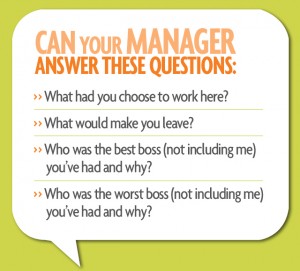
Questions Managers Should AskThe key to keeping the best employees engaged and doing their best work is to ask more questions and make it safe to tell the truth.
  • Do you know why your employees chose your organization and what would make them leave?
  • Do you know your employees’ best and worst boss?
The answers to these questions tells managers what employees need from the organization, job, and from the manager/employee working relationship. Can your manager answer these questions – that I call Candor Questions – about you? For most people, the answer is no. Most managers don’t ask these questions. And most employees are not comfortable giving this information, especially if the manager hasn’t asked for it.

It’s easy to mistake my book, How to Say Anything to Anyone, as a book about giving feedback. It’s not. It takes me nine chapters to get to feedback. The first eight chapters of the book are about how to create relationships in which you can tell the truth without fear. You can read all the feedback books you want and take numerous training classes on coaching, managing people, giving feedback, and managing conflict, and you’ll still be hesitant to speak up, because a formula for giving feedback is not what you’re missing. What’s missing is being given permission and knowing it’s safe to tell the truth.

How to give feedback

Managers, tell your employees:
“I appreciate you choosing to work here. I want this to be the best career move you’ve made, and I want to be the best boss you’ve had. I don’t want to have to guess what’s important to you. I’d like to ask you some questions to get to know you and your career goals better. Please tell me anything you’re comfortable saying. And if you’re not comfortable answering a question, just know that I’m interested and I care. And if, at any point, you’re comfortable telling me, I’d like to know.”
ManagingQThen ask the Candor Questions during job interviews, one-on-one, and team meetings. We’re always learning how to work with people. So continue asking questions throughout your relationships. These conversations are not one-time events.

If you work for someone who isn’t asking you these questions, offer the information. You could say:
“I wanted to tell you why I chose this organization and job, and what keeps me here. I also want to tell you the things I really need to be happy and do my best work. Is it ok if I share?”
Your manager will be caught off guard, but it is likely that she will also be grateful. It’s much easier to manage people when you know what they need and why. Most managers want this information, it just may not occur to them to ask.

If the language above makes you uncomfortable, you can always blame me. You could say:
“I read this blog and the author suggested I tell you what brought me to this organization and what I really need to be happy here and do my best work. She said I’d be easier to manage if you had that information. Is it ok if I share?”
Yes, this might feel a little awkward at first, but the conversation will flow, and both you and your manager will learn a great deal about each other. The ability to tell the truth starts with asking questions, giving people permission to speak candidly, and listening to the answers.

Wednesday, March 26, 2014

Leaving No Stone Unturned


Interview by Annie Sugar

Rhea Williams earned a BS with a double major in Chemistry and Mathematics at Salem College in 2009. CU-Boulder's Chemical and Biological Engineering Department's broad, contemporary energy related research opportunities and its connection to the Colorado Center for Biorefining and Biofuels (C2B2) drew Rhea to Boulder for her doctoral studies. She plans (hopes!) to defend her dissertation and graduate this summer.
 
What are your plans when you finish your degree? How are you preparing for your new career and job hunt after graduation?

My plan post-grad school is to head down an "alternative" PhD career path. By alternative, I mean that I am seeking roles where my scientific knowledge and organizational skills will be a key asset in furthering a company or organization's goals, including scientific program management, scientific publishing, or the coordination and administration of research and development team projects.

I realize these are niche positions to find, so my job hunt is already underway. While attempting to leave no stone unturned, I have availed myself of the help offered by the graduate counselor, Annie Piatt, in CU Career Services. Her critique and advice for my CV and cover letter was timely as I prepared to submit online applications this spring. Another great suggestion Annie gave me was to use LinkedIn's various search mechanisms (by company or within alumni, for example) to find first and second degree connections I could reach out to. My follow up visits to Career Services have been reassuring as I continue the job hunt process and I've appreciated getting an objective person's perspective as I prepare to interview professionally.  

What role does networking play in your career preparation and what skills are you developing to that end?
I believe networking will play a key role in my job hunt. To date, my time in the Research Experience for Undergraduates (REU) program, undergraduate January internships, and professional meeting/conference contacts have already served me well as mentors, with whom I check in periodically for feedback and to ask relevant questions. Their insight and experience helps me explore the possibilities and shape the vision I have for a fulfilling career. Building relationships, demonstrating a professional communication style, and just having the courage to reach out and ask questions are useful skills I'm developing.

What is your networking strategy and how has networking helped you?
My networking strategy is multifaceted and includes emails, periodic check-ins and updates, and getting coffee at conferences over the years. I would encourage other students to find out what works best for them. I have had good success by sending "blind emails" of interest and inquiry to root out opportunities. As an undergrad, I relied on the power of suggestion to open a door at the Environmental Protection Agency (EPA), and they created an internship for me based on my offer to spend my January Term at their Washington DC headquarters. It worked out so well, that the agency now hosts two students every year in the particular program office I worked in. My not-so-secret love for film took me to the Sundance Film Festival in 2009. A straight-to-the-point email to a few folks saying, "Anybody need help?" received a good response and resulted in a volunteer spot in the Theatre Operations office. It's worth mentioning that working the Sundance Film Fest was a goal I'd set for myself a full year prior. I believe sufficient forethought is important so you can "connect the dots" throughout the year and when the time comes, your circumstances are such that you can seize the day.
 
Where have you discovered are good places to network (online and offline)?

Conferences have been fruitful for me, but you need an "in" to help you start conversations. It's hard for anyone to walk up to a stranger! Non-conference aspects of the meeting provide good inroads. Just show some interest and nine times out of ten, the person will be happy and willing to answer your questions and have a discussion with you. Follow up on professional networks such as LinkedIn every time to connect, and be sure to personalize the invitation message rather than rely on the automatic one provided by the site. You can and should follow up fairly soon after the event, being sure to mention an idea or point from their presentation or related to your recent conversation, etc.

Do you have any networking success stories to share?        
A couple recent efforts resulted in multiple beneficial informational phone interviews and invitations to send my resume for personal referral to hiring managers for positions that interested me. The first connection came through a friend I met at my REU, now working in the industry, was linked to a chemist post-doc at Pfizer who then connected me with a chemical engineer in research and manufacturing, which led me to a CU-Boulder chemical engineering undergraduate alum working in the same R&D group. My second connection came via my mother's former employer where an executive business consultant spoke on my behalf to a friend who is working in the oil industry supply chain, Conveniently, this contact's father is a Ph.D. chemical engineer working at LyondellBasell, a large international chemical company.
 
What advice do you have for other graduate students seeking to establish or improve their networking skills or strategies? How should they get started?

Get started by checking out the Career Services website and maybe set up an appointment with Career Services to discuss your personal approach to what can be an overwhelming task. Next, think about a person you can reach out to. This person will feel like a "stretch," someone you haven't spoken to in a long time but you think they might know something that could help you. Reconnect. Send them an update on your accomplishments and current project. Have a goal in mind before you hit the send button. For example, I was seeking an answer to the question "What does an industrial chemical engineer really do?" when I conducted my info interviews.

Basically, you have to put yourself out there on the limb. Don't take it personally if only one out of five attempts nets an offer of help. It's cheesy, but just keep turning over stones until you find a gem. I want to emphasize how important it is to follow through when the contact offers to introduce you to someone or sends you some helpful information or asks you to send your CV. Now is not the time to procrastinate! Promptly read what was sent, reply and ask another relevant question to help move the dialogue forward, eventually building a relationship.

Monday, March 24, 2014

Taking the Road Not Taken

Interview by Annie Sugar


Peter Hutchings started his undergraduate career studying Theater and Film at Northwestern University, but transferred to CU-Boulder where he completed a BA in English Literature and then received an MA in Comparative Literature. After graduation, he left Boulder to pursue his Ph.D. in Comparative Literature at Princeton University where he has also returned to his first love, film-making, while completing his dissertation. After graduation, he intends to continue writing and directing films while publishing independently.

How are you preparing for your career after graduation?
After deliberating at length between a career in academia and one in film-making, I ultimately decided on the latter. In doing so, I diverged from the path most often traveled by graduate students in the Humanities. Yet, ever since I was an undergrad, I have tried to identify basic transferable skills in any course I've taken, whether on Translation Theory, Renaissance poetry, or Spinoza's philosophy, so that I could apply them one day in a chosen career. Close reading, critical thinking, and writing skills stand out to me as the three pillars of my liberal arts education. These tools have equipped me to deal with many aspects of my job as a filmmaker, from screenwriting to script analysis to working with actors.

What role does networking play in your current work, and what is your networking strategy?
As an art form, filmmaking is about collaboration; as an industry, it's about connections. Sometimes these connections come ready-made, like when someone has a family member in the business. In my case, personal connections helped me get my start. But while this type of connection can help you get a foot in the door, you need to work hard to broaden your network.

My strategy is two-part. First, never burn a bridge. I've seen it far too often in the short time I've been in the industry. You never know when a current connection can lead to a future collaboration. There's rarely a good reason to close a door. Second, when I work with talented team-players I keep them in mind for future projects. The old adage is true: a director's only as good as the people with whom he surrounds himself.

How did you learn to network?
My mother worked in television, and my father is a photographer. They're two of the most gregarious people you'll ever meet, and I learned a lot from them. I also found a lot of opportunities to practice networking in graduate school -- not just by forming enduring relationships, but also by watching my professors strike a balance between the personal and professional when dealing with students and colleagues. A lot of this happened outside the classroom at conferences, parties, dinners for invited speakers, etc. In this respect, some of my professors acted as both teachers and models.

Where have you discovered are good places to network both on and offline?
I don't spend a lot of time networking online. That said, I'm one of those people who is on Facebook exclusively for the network. I don't like to approach networking like a shark, and I'm really turned off by people who do, but I like to keep my lines of communication open. Offline, it seems to me that any setting or situation can be fruitful. I was once outside a pizza place waiting for it to open, and I struck up a conversation with the man standing in front of me; it turned out he's a working screenwriter, we exchanged information, and we've kept in touch ever since. For me, it's more about staying open and attentive, and never feeling "above it all."

Is networking different in different parts of the country?
It seems like 90% of the film industry is in Los Angeles and most of the rest is in New York City. I've bucked the system by living in the Hudson Valley, where my next-door neighbor is a herd of cattle. I find this environment very conducive to my creative process, but it has certainly insulated me from some of the realities of the industry. What has struck me is how technology has made a lifestyle like mine possible. Being able to Skype or video chat with actors, writers, producers, and crew members is a great example of how I've been able to work and network without being in one of the industry's main centers.

What advice do you have for graduate students seeking to establish or improve their networking skills beyond academia?
I think one of the real pitfalls of networking is approaching people opportunistically, as if they were rungs on a ladder leading to a successful career. This is not only ethically but also professionally problematic, because people can easily sense when someone's trying to use them or take advantage of them for personal gain. Ambition is a tenuous quality; it rarely identifies goals that bring personal well-being or that engender significant social contributions. I think people respond much more to friendly, open, and cooperative people. You can approach every encounter as a potential opportunity without being opportunistic. The difference is important for many reasons.