Showing posts with label CU students. Show all posts

Monday, April 7, 2014

How to Retain the Best Employees, and Yourself

Written by Shari Harley 

 Managers: 

The fear of saying what we think and asking for what we want at work is prevalent across organizations. We want more money, but don’t know how to ask for it. We want to advance our careers but are concerned about the impression we’ll make if we ask for more. Instead of making requests, many employees assume they won’t get their needs met and choose to leave their jobs, either physically or emotionally.
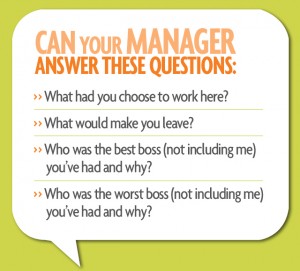
Questions Managers Should AskThe key to keeping the best employees engaged and doing their best work is to ask more questions and make it safe to tell the truth.
  • Do you know why your employees chose your organization and what would make them leave?
  • Do you know your employees’ best and worst boss?
The answers to these questions tells managers what employees need from the organization, job, and from the manager/employee working relationship. Can your manager answer these questions – that I call Candor Questions – about you? For most people, the answer is no. Most managers don’t ask these questions. And most employees are not comfortable giving this information, especially if the manager hasn’t asked for it.

It’s easy to mistake my book, How to Say Anything to Anyone, as a book about giving feedback. It’s not. It takes me nine chapters to get to feedback. The first eight chapters of the book are about how to create relationships in which you can tell the truth without fear. You can read all the feedback books you want and take numerous training classes on coaching, managing people, giving feedback, and managing conflict, and you’ll still be hesitant to speak up, because a formula for giving feedback is not what you’re missing. What’s missing is being given permission and knowing it’s safe to tell the truth.

How to give feedback

Managers, tell your employees:
“I appreciate you choosing to work here. I want this to be the best career move you’ve made, and I want to be the best boss you’ve had. I don’t want to have to guess what’s important to you. I’d like to ask you some questions to get to know you and your career goals better. Please tell me anything you’re comfortable saying. And if you’re not comfortable answering a question, just know that I’m interested and I care. And if, at any point, you’re comfortable telling me, I’d like to know.”
ManagingQThen ask the Candor Questions during job interviews, one-on-one, and team meetings. We’re always learning how to work with people. So continue asking questions throughout your relationships. These conversations are not one-time events.

If you work for someone who isn’t asking you these questions, offer the information. You could say:
“I wanted to tell you why I chose this organization and job, and what keeps me here. I also want to tell you the things I really need to be happy and do my best work. Is it ok if I share?”
Your manager will be caught off guard, but it is likely that she will also be grateful. It’s much easier to manage people when you know what they need and why. Most managers want this information, it just may not occur to them to ask.

If the language above makes you uncomfortable, you can always blame me. You could say:
“I read this blog and the author suggested I tell you what brought me to this organization and what I really need to be happy here and do my best work. She said I’d be easier to manage if you had that information. Is it ok if I share?”
Yes, this might feel a little awkward at first, but the conversation will flow, and both you and your manager will learn a great deal about each other. The ability to tell the truth starts with asking questions, giving people permission to speak candidly, and listening to the answers.

Wednesday, April 2, 2014

#GoBuffsPro: How Becoming a Buffs Professional Can Benefit You

-->Written by Lauren Lind
Stand out with the Buffs Professional Program certificate! These four workshops offered by Career Services are designed to prepare you for the professional work world.  Learn what it takes to transition into the professional world after college.

April is your last chance this semester to earn your Buffs Professional Program certificate! Simply attend the four workshops (or participate in them online) and attend the career fair. Once you've completed the required workshops and attended the career fair, you'll be invited to attend the Summit event on April 24th. You do not have to complete the classes in any particular order. Below are the in-person workshops.

Explore Majors and Careers
Tuesday, April 8th, 5:30-6:30pm, S350
Learn about majors you're interested in and career assessments. This workshop will allow you to connect your strengths and skills to areas of interest.

Resumes & Networking
Tuesday, April 15th, 5:30-6:30pm, S350
It has been said that 80% of jobs are found through networking. Often times it’s about whom you know and getting your foot in the door.  During this class you can craft a resume from scratch or work on your existing resume.

Internship/Job Search & Interviewing
Tuesday, April 22nd, 5:30-6:30pm, S350
Begin the internship and job search process and learn the ins and outs of how to be successful in your search. This class emphasizes building social media job searching skills and interviewing skills to put you ahead of the competition.

Professionalism Skills
Tuesday, April 29th, 5:30-6:30pm, S350
Gain insight into professionalism on the job and skills to adapt to changing work environments. Learn the professional skills that employers seek in candidates.

This is a unique opportunity to make your application stand out and understand what employers are looking for in candidates. Click here to see the student requirements. 

To get started, email: BuffsPro@Colorado.edu with your student ID number. The Buffs Professional Program is managed through Desire2Learn, so you can attend workshops in person or online.

Wednesday, March 12, 2014

They’re Just Not That Into You, but Why?

Written by Lauren Lind


You think you aced the interview but you still haven’t heard back. You got good vibes from the recruiters and the conversation flowed perfectly, so what’s the deal?

Here are a few reasons why the employer may just not be that into you:

• When the recruiter asked if you had any questions you said “no.”

• Your social media profile has inappropriate posts.

• You forgot to send a thank you email or card.

   You only sent a thank you email, but neglected to send a handwritten card as well. Some employers will only talk to interviewees who handwrite their thank you cards.

• You called the recruiter to personally thank them and tell them every detail about why you loved interviewing with them.

• Your thank you card was overly detailed and slightly creepy.

• You sent a thank you card but never followed up again one to two weeks after the
interview. 

• Many interviewers are trained to be “players.” They want to make every candidate feel wanted. Don’t become too comfortable during your interview. Make sure you are answering questions professionally with support to back up your claims.

And last but not least…
• You simply were not the best candidate for the position.

Feeling neglected after an interview hurts the ego, but don’t let it hurt your chances to learn from each interviewing experience. After each interview, even if it’s an informational interview, be sure to thank the employer genuinely, but don’t go over the top, and follow up appropriately.

There are many reasons why the employer has decided to pick a different candidate so don’t be too hard on yourself. The right employment match is out there for you; stay positive and remain persistent in your job search. With any relationship (personal or professional) always remain calm, collected, and respectful in the face of rejection. Crazy isn’t a good look on anyone. Don’t speak ill of any organization and definitely do not dis the company that decided to hire a different candidate on the internet. Word spreads like wildfire, especially in our technology saturated society.

For advice on job search andinterviewing skills, save the date for Career Services Buffs Pros event on Wednesday, March 19th at 5:30 pm in the Center for Community S350.

Monday, February 24, 2014

Stay Classy CU

Written by Lauren Lind 
Adapting to an ever-changing world can be a difficult task when it comes to entering a job right out of college. Going from 4 years of schooling and a bit of leniency to working a 9 to 5 job can be a shock to many graduates. There are many fantastic skills that we learn throughout those four years at school, however, there are simply some skills that are required for a professional job that we do not learn in class. Developing professionalism skills can help make your transition easier and make you an even more qualified candidate. You may look great on paper, but if you don’t know how to behave on the job, chances are you may not be there long enough to learn. CU is an outstanding university academically, but be prepared to prove to employers that you are serious about working for them.
Here are some key attributes of professionalism that you can work on to help you keep it classy and remain appropriate:
• Specialized knowledge. You can work on this by building expertise in a specific area and staying current with any changes in that area.
• Competency. Work on actively listening to others and observing situations with empathy. This will help to develop your emotional intelligence.
• Honesty and integrity. Don’t be a flake. If you agree to something, stand by your commitment. If you are going to miss a deadline, make sure you have open communication with your boss and co-workers.  
• Respect. Use your manners. It might sound simple, however, sometimes we forget basic kindness and good manners when it comes to dealing with people we don’t like.
• Accountability. Hold yourself to a standard. This also ties in with not being a flake because you want others to be able to count on you. Show up mentally present and with the tools you need to complete tasks.
• Self-regulation. You are the only person who can control your actions and thoughts. Set goals and strive to reach them. Your boss does not want to be constantly nagging you to do your job. If that becomes the case, you might not have a job anymore.
• Image. The way you speak, dress, act, and perform are all very influential upon your image. Your online presence also reflects your image. Be yourself, but remember to be professional in the workplace.

For more information on professionalism, be sure to check out the Professionalism Skills workshop tomorrow, February 25th, in the Center For Community S350 from 5:30-6:30pm. This event will be hosted by Career Services.


Hat tip: Mindtools.com