Showing posts with label CU graduates. Show all posts

Monday, April 7, 2014

How to Retain the Best Employees, and Yourself

Written by Shari Harley 

 Managers: 

The fear of saying what we think and asking for what we want at work is prevalent across organizations. We want more money, but don’t know how to ask for it. We want to advance our careers but are concerned about the impression we’ll make if we ask for more. Instead of making requests, many employees assume they won’t get their needs met and choose to leave their jobs, either physically or emotionally.

Questions Managers Should AskThe key to keeping the best employees engaged and doing their best work is to ask more questions and make it safe to tell the truth.
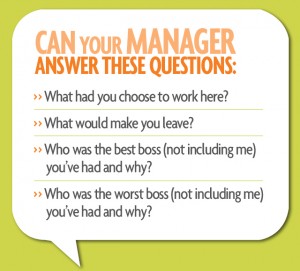
  • Do you know why your employees chose your organization and what would make them leave?
  • Do you know your employees’ best and worst boss?
The answers to these questions tells managers what employees need from the organization, job, and from the manager/employee working relationship. Can your manager answer these questions – that I call Candor Questions – about you? For most people, the answer is no. Most managers don’t ask these questions. And most employees are not comfortable giving this information, especially if the manager hasn’t asked for it.

It’s easy to mistake my book, How to Say Anything to Anyone, as a book about giving feedback. It’s not. It takes me nine chapters to get to feedback. The first eight chapters of the book are about how to create relationships in which you can tell the truth without fear. You can read all the feedback books you want and take numerous training classes on coaching, managing people, giving feedback, and managing conflict, and you’ll still be hesitant to speak up, because a formula for giving feedback is not what you’re missing. What’s missing is being given permission and knowing it’s safe to tell the truth.

How to give feedback

Managers, tell your employees:
“I appreciate you choosing to work here. I want this to be the best career move you’ve made, and I want to be the best boss you’ve had. I don’t want to have to guess what’s important to you. I’d like to ask you some questions to get to know you and your career goals better. Please tell me anything you’re comfortable saying. And if you’re not comfortable answering a question, just know that I’m interested and I care. And if, at any point, you’re comfortable telling me, I’d like to know.”
ManagingQThen ask the Candor Questions during job interviews, one-on-one, and team meetings. We’re always learning how to work with people. So continue asking questions throughout your relationships. These conversations are not one-time events.

If you work for someone who isn’t asking you these questions, offer the information. You could say:
“I wanted to tell you why I chose this organization and job, and what keeps me here. I also want to tell you the things I really need to be happy and do my best work. Is it ok if I share?”
Your manager will be caught off guard, but it is likely that she will also be grateful. It’s much easier to manage people when you know what they need and why. Most managers want this information, it just may not occur to them to ask.

If the language above makes you uncomfortable, you can always blame me. You could say:
“I read this blog and the author suggested I tell you what brought me to this organization and what I really need to be happy here and do my best work. She said I’d be easier to manage if you had that information. Is it ok if I share?”
Yes, this might feel a little awkward at first, but the conversation will flow, and both you and your manager will learn a great deal about each other. The ability to tell the truth starts with asking questions, giving people permission to speak candidly, and listening to the answers.

Wednesday, March 26, 2014

Leaving No Stone Unturned


Interview by Annie Sugar

Rhea Williams earned a BS with a double major in Chemistry and Mathematics at Salem College in 2009. CU-Boulder's Chemical and Biological Engineering Department's broad, contemporary energy related research opportunities and its connection to the Colorado Center for Biorefining and Biofuels (C2B2) drew Rhea to Boulder for her doctoral studies. She plans (hopes!) to defend her dissertation and graduate this summer.
 
What are your plans when you finish your degree? How are you preparing for your new career and job hunt after graduation?

My plan post-grad school is to head down an "alternative" PhD career path. By alternative, I mean that I am seeking roles where my scientific knowledge and organizational skills will be a key asset in furthering a company or organization's goals, including scientific program management, scientific publishing, or the coordination and administration of research and development team projects.

I realize these are niche positions to find, so my job hunt is already underway. While attempting to leave no stone unturned, I have availed myself of the help offered by the graduate counselor, Annie Piatt, in CU Career Services. Her critique and advice for my CV and cover letter was timely as I prepared to submit online applications this spring. Another great suggestion Annie gave me was to use LinkedIn's various search mechanisms (by company or within alumni, for example) to find first and second degree connections I could reach out to. My follow up visits to Career Services have been reassuring as I continue the job hunt process and I've appreciated getting an objective person's perspective as I prepare to interview professionally.  

What role does networking play in your career preparation and what skills are you developing to that end?
I believe networking will play a key role in my job hunt. To date, my time in the Research Experience for Undergraduates (REU) program, undergraduate January internships, and professional meeting/conference contacts have already served me well as mentors, with whom I check in periodically for feedback and to ask relevant questions. Their insight and experience helps me explore the possibilities and shape the vision I have for a fulfilling career. Building relationships, demonstrating a professional communication style, and just having the courage to reach out and ask questions are useful skills I'm developing.

What is your networking strategy and how has networking helped you?
My networking strategy is multifaceted and includes emails, periodic check-ins and updates, and getting coffee at conferences over the years. I would encourage other students to find out what works best for them. I have had good success by sending "blind emails" of interest and inquiry to root out opportunities. As an undergrad, I relied on the power of suggestion to open a door at the Environmental Protection Agency (EPA), and they created an internship for me based on my offer to spend my January Term at their Washington DC headquarters. It worked out so well, that the agency now hosts two students every year in the particular program office I worked in. My not-so-secret love for film took me to the Sundance Film Festival in 2009. A straight-to-the-point email to a few folks saying, "Anybody need help?" received a good response and resulted in a volunteer spot in the Theatre Operations office. It's worth mentioning that working the Sundance Film Fest was a goal I'd set for myself a full year prior. I believe sufficient forethought is important so you can "connect the dots" throughout the year and when the time comes, your circumstances are such that you can seize the day.
 
Where have you discovered are good places to network (online and offline)?

Conferences have been fruitful for me, but you need an "in" to help you start conversations. It's hard for anyone to walk up to a stranger! Non-conference aspects of the meeting provide good inroads. Just show some interest and nine times out of ten, the person will be happy and willing to answer your questions and have a discussion with you. Follow up on professional networks such as LinkedIn every time to connect, and be sure to personalize the invitation message rather than rely on the automatic one provided by the site. You can and should follow up fairly soon after the event, being sure to mention an idea or point from their presentation or related to your recent conversation, etc.

Do you have any networking success stories to share?        
A couple recent efforts resulted in multiple beneficial informational phone interviews and invitations to send my resume for personal referral to hiring managers for positions that interested me. The first connection came through a friend I met at my REU, now working in the industry, was linked to a chemist post-doc at Pfizer who then connected me with a chemical engineer in research and manufacturing, which led me to a CU-Boulder chemical engineering undergraduate alum working in the same R&D group. My second connection came via my mother's former employer where an executive business consultant spoke on my behalf to a friend who is working in the oil industry supply chain, Conveniently, this contact's father is a Ph.D. chemical engineer working at LyondellBasell, a large international chemical company.
 
What advice do you have for other graduate students seeking to establish or improve their networking skills or strategies? How should they get started?

Get started by checking out the Career Services website and maybe set up an appointment with Career Services to discuss your personal approach to what can be an overwhelming task. Next, think about a person you can reach out to. This person will feel like a "stretch," someone you haven't spoken to in a long time but you think they might know something that could help you. Reconnect. Send them an update on your accomplishments and current project. Have a goal in mind before you hit the send button. For example, I was seeking an answer to the question "What does an industrial chemical engineer really do?" when I conducted my info interviews.

Basically, you have to put yourself out there on the limb. Don't take it personally if only one out of five attempts nets an offer of help. It's cheesy, but just keep turning over stones until you find a gem. I want to emphasize how important it is to follow through when the contact offers to introduce you to someone or sends you some helpful information or asks you to send your CV. Now is not the time to procrastinate! Promptly read what was sent, reply and ask another relevant question to help move the dialogue forward, eventually building a relationship.

Monday, March 24, 2014

Taking the Road Not Taken

Interview by Annie Sugar


Peter Hutchings started his undergraduate career studying Theater and Film at Northwestern University, but transferred to CU-Boulder where he completed a BA in English Literature and then received an MA in Comparative Literature. After graduation, he left Boulder to pursue his Ph.D. in Comparative Literature at Princeton University where he has also returned to his first love, film-making, while completing his dissertation. After graduation, he intends to continue writing and directing films while publishing independently.

How are you preparing for your career after graduation?
After deliberating at length between a career in academia and one in film-making, I ultimately decided on the latter. In doing so, I diverged from the path most often traveled by graduate students in the Humanities. Yet, ever since I was an undergrad, I have tried to identify basic transferable skills in any course I've taken, whether on Translation Theory, Renaissance poetry, or Spinoza's philosophy, so that I could apply them one day in a chosen career. Close reading, critical thinking, and writing skills stand out to me as the three pillars of my liberal arts education. These tools have equipped me to deal with many aspects of my job as a filmmaker, from screenwriting to script analysis to working with actors.

What role does networking play in your current work, and what is your networking strategy?
As an art form, filmmaking is about collaboration; as an industry, it's about connections. Sometimes these connections come ready-made, like when someone has a family member in the business. In my case, personal connections helped me get my start. But while this type of connection can help you get a foot in the door, you need to work hard to broaden your network.

My strategy is two-part. First, never burn a bridge. I've seen it far too often in the short time I've been in the industry. You never know when a current connection can lead to a future collaboration. There's rarely a good reason to close a door. Second, when I work with talented team-players I keep them in mind for future projects. The old adage is true: a director's only as good as the people with whom he surrounds himself.

How did you learn to network?
My mother worked in television, and my father is a photographer. They're two of the most gregarious people you'll ever meet, and I learned a lot from them. I also found a lot of opportunities to practice networking in graduate school -- not just by forming enduring relationships, but also by watching my professors strike a balance between the personal and professional when dealing with students and colleagues. A lot of this happened outside the classroom at conferences, parties, dinners for invited speakers, etc. In this respect, some of my professors acted as both teachers and models.

Where have you discovered are good places to network both on and offline?
I don't spend a lot of time networking online. That said, I'm one of those people who is on Facebook exclusively for the network. I don't like to approach networking like a shark, and I'm really turned off by people who do, but I like to keep my lines of communication open. Offline, it seems to me that any setting or situation can be fruitful. I was once outside a pizza place waiting for it to open, and I struck up a conversation with the man standing in front of me; it turned out he's a working screenwriter, we exchanged information, and we've kept in touch ever since. For me, it's more about staying open and attentive, and never feeling "above it all."

Is networking different in different parts of the country?
It seems like 90% of the film industry is in Los Angeles and most of the rest is in New York City. I've bucked the system by living in the Hudson Valley, where my next-door neighbor is a herd of cattle. I find this environment very conducive to my creative process, but it has certainly insulated me from some of the realities of the industry. What has struck me is how technology has made a lifestyle like mine possible. Being able to Skype or video chat with actors, writers, producers, and crew members is a great example of how I've been able to work and network without being in one of the industry's main centers.

What advice do you have for graduate students seeking to establish or improve their networking skills beyond academia?
I think one of the real pitfalls of networking is approaching people opportunistically, as if they were rungs on a ladder leading to a successful career. This is not only ethically but also professionally problematic, because people can easily sense when someone's trying to use them or take advantage of them for personal gain. Ambition is a tenuous quality; it rarely identifies goals that bring personal well-being or that engender significant social contributions. I think people respond much more to friendly, open, and cooperative people. You can approach every encounter as a potential opportunity without being opportunistic. The difference is important for many reasons.

Tuesday, March 18, 2014

Changing Careers and the World


Written by  Interview by Annie Sugar, Writer/Editor, Career Services Future 411 Graduate Student Newsletter
 
Allison Freedman started her career with a BSEd from Northwestern University and later returned to school to get an MA in Middle (Near) Eastern Studies at New York University. After several years working in a variety of roles in education and nonprofit management and parenting her her twin sons, Allison returned to school once more and is currently working on her MBA at CU-Boulder.

How did your career goals lead you into your master's degrees? How did your first master's degree change and shape your career?
I was getting ready for class in my midtown apartment when the first plane struck the World Trade Centers. I was concerned about being late for my Arabic test, so I hurried out and was on a subway underground when they fell. The trains were stopped, and I emerged from the subway station into a world that seemed so different than the one I had known just an hour before.

I always wanted to focus my career on the developing world, particularly the Middle East and its languages and cultures, but September 11th changed that because, ironically, no one seemed to know how to use my skills.  I had an apartment and school loans, combined with a variety of skills and interests, so I embarked upon the challenge of teaching about the world in a difficult New York City public school instead.  From my first master's degree, I learned Arabic and acquired a framework for ideas about the Middle East and the world that I had gained from traveling, living, and working overseas.  I learned a great deal from my students, colleagues, the community and the experience.  And I worked tirelessly to ensure that my students, colleagues, and the community learned from me as well.

What made you decide to pursue your MBA and why at CU-Boulder? What are your plans when you finish your degree?
I always wanted to better the world, or at least do my part toward that end. Although I was always grateful for the contributions I had the opportunity to make to lives and communities through education and nonprofit work, I began to yearn for something different.  There were other skills and global perspectives I wanted to share, but there was no appropriate forum to do so in those environments.  It became obvious to me that, in addition to education, nurturing financial stability was a critical element in improving people's lives. In turn, overall better living standards can foster environments where conflict can be replaced by peace. I still wanted to improve the world, and I recognized that I needed to update and/or learn many of the skills taught in an MBA program to help me to do this. I decided to pursue an MBA for the chance to acquire tools to rejoin the workforce in a new way, to take on a new role with broader, global impact.

Having learned the value of connecting with the surrounding community as part of an academic experience, I waited until I was living in a location in which I was eager to invest and could commit to before deciding to go back to school. I finally made my way back to Colorado and, once settled, began the process of researching and applying to business schools.

At CU-Boulder's MBA program, I am learning core business skills, such as how to read key financial statements.  The entrepreneurial spirit that flows through campus from the startup culture that surrounds it is invigorating.  I am discovering how ethics and sustainable initiatives can play an integral role in many businesses and that there are opportunities to connect these to my own values in a meaningful and productive way.  I am getting out into the community, meeting people and learning from local business leaders, through school and community-sponsored events and leadership roles in several students groups.

How did you know you wanted to make a career change? What changes do you want to make? What does graduate school offer as a means to this end that you couldn't get with any other instrument of change?
As a parent, it quickly became more important for my children to see me working hard toward something that is very important to me, even if for me that "something" takes me out of the house and back to school toward a brand new career.  I think it's important for me to do, and it's important for me to model values of global connectedness, working hard, and peace.

When I first entered the workforce almost 20 years ago, there were many skills that you could simply learn on the job.  Employers were willing to hire you for your ability to think and learn.  Job searching no longer works quite the same way, and many other people looking for work will already have many of the essential skills that employers value and graduate school offers me the opportunity to show my commitment to acquiring the most critical skills and my ability to still grow and learn.

What advice do you have for other graduate students seeking to use their degree programs to change careers?
I love learning, but from years as a student, teacher, and supporter of students and teachers, I will be the first to say that the classroom is not the right place for everyone.  Many of the skills and tools I am learning I might have been able to acquire through on-the-job training, but it might be harder to find the "right" job when you are in a quest for a new direction. I think it's too easy to get off track or find yourself needing to make several job changes in order to get where you are trying to go.  I think that - for people with drive and commitment - graduate school offers a powerful, respected way to acquire a solid foundation in a discipline or industry to lead you where you are going in a much more straightforward way.

How are you preparing for your new career and job hunt after graduation?
I feel fortunate to have the support and resources both targeting the MBA students here at Leeds, as well as the general career services of the broader university in my efforts to find an internship and ultimately a new job and career after graduation. This support has been clear and readily available and it helps me to embark upon these next steps with the greatest possible confidence and preparedness.

Through the MBA program, the emphasis on setting career goals and taking strategic steps toward meeting those goals is something that begins with the orientation before classes. The staff is enthusiastic and dedicated and provides opportunities for students to evaluate their career interests, develop their own job search skills, and take advantage of all that networking has to offer.

As part of the effort to develop our job search skills, the MBA program invited Annie Piatt from Career Services to present to our entire class. She provided invaluable advice and resources that helped me emphasize important skills and processes when looking for an internship or job, and broaden my perspective about possible career trajectories. Her presentation make me aware of the wealth of additional services available to MBA students through the CU Career Services as well.  In only one semester on campus, I have already found Annie to be a refreshing source of support and guidance as well as an additional voice of critique and guidance as I embark on the internship search in earnest. 

Wednesday, March 12, 2014

They’re Just Not That Into You, but Why?

Written by Lauren Lind


You think you aced the interview but you still haven’t heard back. You got good vibes from the recruiters and the conversation flowed perfectly, so what’s the deal?

Here are a few reasons why the employer may just not be that into you:

• When the recruiter asked if you had any questions you said “no.”

• Your social media profile has inappropriate posts.

• You forgot to send a thank you email or card.

•   You only sent a thank you email, but neglected to send a handwritten card as well. Some employers will only talk to interviewees who handwrite their thank you cards.

• You called the recruiter to personally thank them and tell them every detail about why you loved interviewing with them.

• Your thank you card was overly detailed and slightly creepy.

• You sent a thank you card but never followed up again one to two weeks after the
interview. 

• Many interviewers are trained to be “players.” They want to make every candidate feel wanted. Don’t become too comfortable during your interview. Make sure you are answering questions professionally with support to back up your claims.

And last but not least…
• You simply were not the best candidate for the position.

Feeling neglected after an interview hurts the ego, but don’t let it hurt your chances to learn from each interviewing experience. After each interview, even if it’s an informational interview, be sure to thank the employer genuinely, but don’t go over the top, and follow up appropriately.

There are many reasons why the employer has decided to pick a different candidate so don’t be too hard on yourself. The right employment match is out there for you; stay positive and remain persistent in your job search. With any relationship (personal or professional) always remain calm, collected, and respectful in the face of rejection. Crazy isn’t a good look on anyone. Don’t speak ill of any organization and definitely do not dis the company that decided to hire a different candidate on the internet. Word spreads like wildfire, especially in our technology saturated society.

For advice on job search andinterviewing skills, save the date for Career Services Buffs Pros event on Wednesday, March 19th at 5:30 pm in the Center for Community S350.

Thursday, April 26, 2012

Negotiating the First Year of Rest of Your Professional Life

By Max Gompertz, senior communication and psychology major at CU-Boulder

While the transition from student to employee is undoubtedly a difficult one, some simple tips can make the shift much less intimidating.  These pointers will help you navigate the first year of professional employment.  Instead of allowing negative feelings like anxiety, uncertainty, or doubt to preoccupy you on the first day of the rest of your life, take advantage of this straightforward advice to keep calm and carry on.

Get Ready

1)   Review:  Look over the literature that you likely received when you were hired for the job.  Information about vacation time, sick days, and payment methods specific to the company will be included, and is expected to be common knowledge among all employees.  Asking questions for which you were already provided the answer will make you look irresponsible and unorganized in the employer’s eyes, so read up beforehand!
2)   Dress:  …to impress! Employers like to see employees who respect and enjoy their job.  Spend some time at a local suit vendor to select clothes that fit right, look professional and make you feel confident.  Confidence is the key to establishing yourself as a valuable addition to the company.

Get Set
3)   Get Organized:  Taking notes on your first day will make you look sharp, organized and motivated.  This will set a great foundation for you to begin your new job, and you’ll impress your superiors!  Although note taking may occur more often in college than in the corporate world, continuing this good habit throughout your life will put you a step ahead of your coworkers as well as help you focus and better understand what is expected of you.
4)   Attitude:  During the first weeks of employment, anything can happen… so be prepared.  As noted in McGill University’s Career Planning Service, it is crucial to be “positive and flexible” during your first year of employment.  Since your workflow probably won’t become concrete for the first few weeks, volunteering to help with whatever you can and exuding a positive attitude will make you stand out amongst other employees.
5)   Initiative:  Make a point to introduce yourself to coworkers.  Rather than waiting for other employees to introduce themselves, be outgoing and take the initiative to begin the introduction. Not only should you apply this to peers and coworkers, but McGill University also recommends that you “get to know your boss.” This advice may seem like a no-brainer, however, getting to know your boss is one of the best ways to get recognized internally and move up at a company.
6)   Attention:  Don’t overlook any details during your first year on the job.  Your superiors will be carefully checking your work, so it’s important to be careful not to miss anything.  Make sure you dot your I’s and cross your T’s if you want to find success during the first year of your new job.

GO!

7)   Culture:  As highlighted by the University of Missouri Career Center, be sure to “learn the organizational culture” at your new job.  Employees who understand the management styles and reward mechanisms their employers use will be more likely to benefit than those who don’t take the time to understand the company culture.
8)   Position:  Employees are encouraged to “learn their place” in order to make the biggest impact on their company’s profitability.  The connotation here is not one of penalty or ability, but rather, refinement and productivity.  In college, we were taught to speak up, but make sure you pause and think before doing so.  It is not to say that companies or employers do not value your opinion, but you must be careful not to waste their time on redundancies or trivialities.  Therefore, know your position and what contributions are expected of you.


Additional information can be found on these sites:

Tuesday, April 19, 2011

Getting the Most Out of Your Professional Experience

So after months of talking about how to land that job or internship with resume, cover letter, interviewing, networking, and social networking preparation, your first day is coming up. Summer is around the corner and you have that summer internship or job all lined up…but now what? Sure, the hard part of finding and being accepted for a position is over, but having a strategy to be a valued employee or intern while learning and having the best professional experience possible is still important!

Being a successful professional is a topic that has been discussed around the country and world by notable experts. After researching a variety of career blogs, websites, and articles here are the tips needed to make the most out of your experience.

1. Be timely and efficient!

Like any interview or important meeting being on time to the job or internship is extremely important! When you establish right off the bat that you are there on time and ready to go – you are subconsciously letting your co-workers know that you care and are ready to go. Starting off the day late can often times negatively affect your performance throughout the rest of your day.

2. Dress for Success

Always dress professionally. Although it is important to dress to the environment you’re in, always remember that you’re the one who is trying to either get a job or move up in the job you’re in. On your first day, take a look at what your superiors are wearing and imitate their level of professional dress.

“When I was an intern at CBS4 News, when talking about professional dress attire, our internship coordinator said, ‘Don’t just be professional, look professional. Remember we already have our jobs, you’re still trying to get one.’” – Brittany Moore

It is ALWAYS better to over dress than under dress. Again, subconsciously by dressing professionally, you are demonstrating to your peers that you are serious and care about what you’re working on.

3. Take the initiative and seek out MORE opportunities

This is probably one of the most important parts of making the most out of your experience. Remember, although you may be working and helping the company, at the end of the day it’s important to keep in mind what YOU’RE taking away from the experience. One of the most valuable and notable things you can have on your resume is your experience – so always be seeking new ways to gain that experience. Take on the mindset that the more opportunities you seek out, the better skills you will gain and can add to your resume.

Keep in mind that during internships, your co-workers and superiors aren’t going to hold your hand and guide you to every possible experience. They have their own jobs to worry about and aren’t going to know what you are interested in learning. Simply ask! Your superiors will almost always be willing to help and show you things, but they won’t know what you’re interested in until you ASK!

4. Find a mentor

Finding someone in your industry you can seek out for advice and questions is an invaluable asset you should always be on the lookout for. Career blogger Penelope Trunk lists in her blog 7 Ways to Find and Keep a Mentor…

1. Identify a potential mentor
2. Have good questions
3. Don’t expect miracles
4. Be a good listener
5. Prove you’re serious
6. Always be on the lookout
7. Give back

To find out more mentorship tips, visit Penelope’s Blog

5. Be trustworthy and dependable

Whether you’re an intern or an employee, the company you are working with has established some level of trust in you. Regardless of whether the company is depending on your confidentiality or your ability to get a job done, trust has been given to you. One of the most important things to learn in the professional world is NOT to burn any bridges. The quickest way to burn a bridge is by losing someone’s trust or failing to get something finished. You never know when that burnt bridge may come back to haunt you. It’s a small world and people talk; you want to make sure they are saying only the best about you!

6. Do more than what is expected!

The best ways to get noticed, build relationships, and gain opportunities is by going above and beyond the expectations. If you are always jumping at opportunities, spending extra time on projects, and helping anyway you can, your efforts will be noticed and could result in great experiences and opportunities. Who knows, you might even be recommended for or offered a job just by putting in some extra effort.

7. Network every chance you get!

Just because you have already landed the job or internship does NOT mean you stop networking – it means you network MORE! Now that you are in the professional environment, it will be much easier to network and build relationships with clients and co-workers. Remember, it’s not just about what you do, but also who you know.

8. Show up ready and excited!

There is something to be said about being effective and efficient while on the clock. Being responsible and getting the appropriate amount of sleep, eating right, etc. will all improve your attitude and ability to perform while on the job. You can’t make the most out of your experience if you’re not in the right frame of mind to do so!

9. Evaluate the company and industry

Remember, you are just starting your professional career and should be evaluating whether that job or internship is what you want to continue doing. Entry-level jobs and internships are meant for testing out the waters and seeing if this industry or job is really what you want to be spending your time doing. You have many years to work and it is important to always evaluate your professional experiences and decide whether or not you are happy with your work.

10. Be on the lookout for portfolio fillers

Whether you are trying to build your resume, website, or blog content, you should always be on the lookout for ways to collect examples of your work. Chances are your future employer will want to see examples of your work. Internships and entry-level jobs are the perfect time to start collecting samples of your work. Additionally, this is a perfect opportunity to ask your mentor or a co-worker you have closely worked with to write a recommendation letter for you. Letters of recommendation will come in handy with future job applications.

Hopefully these tips have made you feel more confident during your professional experiences this summer or in the near future. Don’t forget that you don’t have to figure everything out on your own! CU-Boulder Career Services will be open all summer and invites you to come in, ask questions, and seek advice. For more information about summer hours and programs visit our website.

Tuesday, October 26, 2010

Careers in the Spotlight: Working for a social media agency

One of the great things about going to school in Boulder is that career opportunities abound in such a technologically advanced city. Elyse Heslin is just one CU graduate ('10) whose pre-graduation career search led her to job in an industry she is passionate about. (more...)